Key Features of Greenhouse Gearboxes
Selecting the right greenhouse gearbox means understanding the technical features that separate a reliable horticultural drive from a generic industrial reducer. Greenhouse environments combine permanent moisture, fertiliser salts, UV exposure, and the need for maintenance-free operation over many seasons — requirements that push gearbox design in very specific directions. Below we examine the engineering features that define a professional-grade greenhouse gearbox, covering ventilation, rolling film, and shading curtain variants.

1. Self-Locking Worm Gear Mechanism
The most critical feature of any greenhouse gearbox is its self-locking capability. A worm-and-wheel gear set with a lead angle below the friction angle prevents back-driving — meaning the output shaft (and attached film or curtain) cannot move unless the input is actively driven. This eliminates the need for separate braking mechanisms on rolling film and shading curtain systems. When a shading curtain gearbox deploys an aluminet screen at 70% closure, it stays precisely there even when wind creates lateral load on the fabric.
2. Weatherproof, Sealed Housing
Commercial greenhouses subject gearboxes to year-round humidity often exceeding 90% RH, condensation cycles, overhead irrigation spray, and washing-down routines. Quality greenhouse gearboxes feature:
- Die-cast aluminium housing — resists corrosion and dissipates heat effectively.
- IP55 or higher ingress protection — sealed against dust and low-pressure water jets.
- Double-lip shaft seals — prevent moisture tracking along output shafts.
- Corrosion-resistant fasteners — stainless steel bolts prevent galvanic corrosion from fertiliser solutions.
3. High Torque-to-Size Ratio
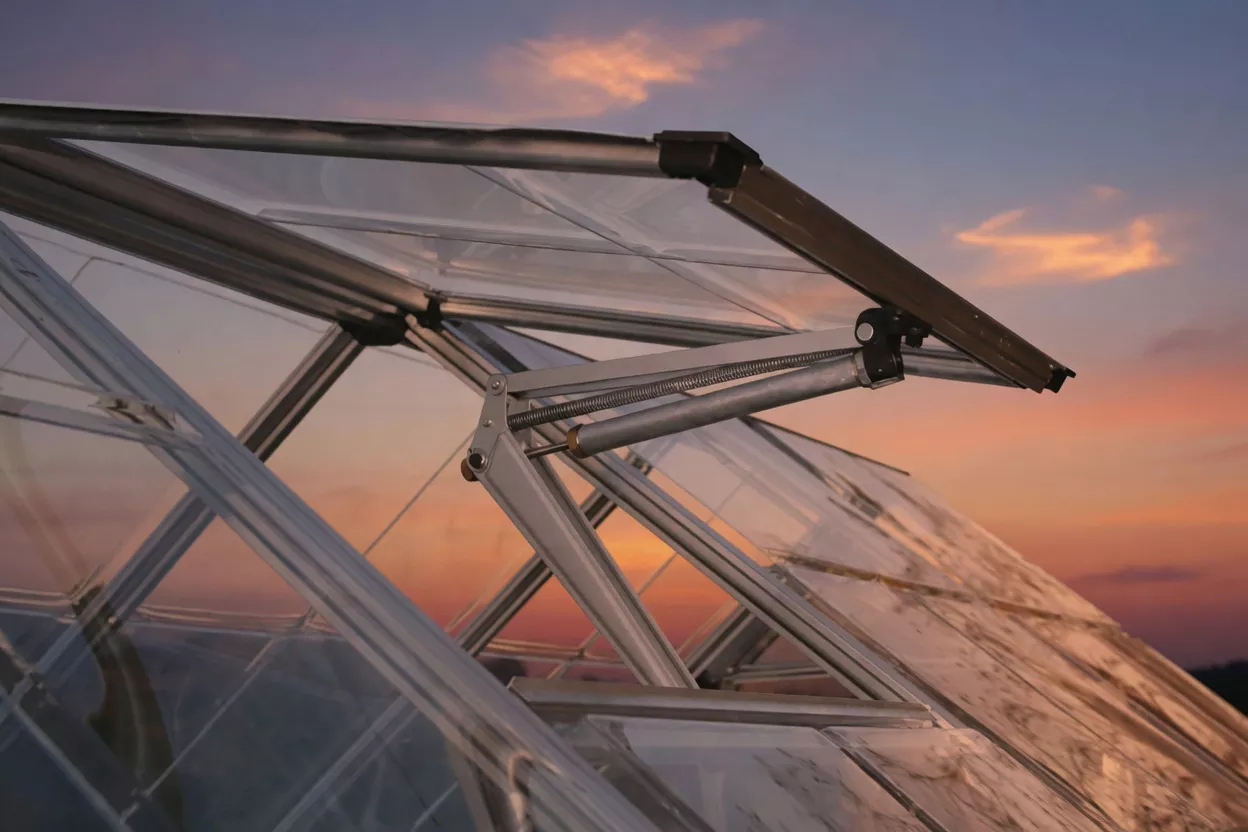
A ventilation gearbox mounted on a greenhouse ridge rail must deliver enough torque to open heavy glass or polycarbonate panels against wind resistance, yet occupy minimal space so it doesn’t obstruct gutter drainage or overhead conveyors. Worm reduction achieves gear ratios of 12:1 to 80:1 in a single stage, inside a unit no larger than a hardback book. For rolling film applications, 60–100 Nm of output torque is sufficient to raise polyethylene film panels spanning up to 160 metres when properly guided.
4. Dual Input Options — Manual and Motorised
Professional greenhouse gearboxes are designed to accept both hand-crank (manual) and electric motor input. The standard input configuration features a hexagonal or square bore that fits a cordless drill or dedicated hand wheel. Motorised versions attach a 3-phase or single-phase AC motor, or a 24 V DC motor for solar-powered greenhouse systems. This dual capability makes the same gearbox body suitable for a small family farm or a large climate-controlled complex simply by changing the drive arrangement.
5. Right-Angle 90° Output Configuration
Greenhouse mounting constraints — particularly in gutter-to-gutter or Venlo-style glass houses — require the drive shaft to run horizontally while the output shaft runs perpendicular. The 90° shaft arrangement inherent in worm gearboxes perfectly matches the roll-bar and rack-and-pinion geometry of standard greenhouse vent and curtain systems. This feature simplifies bracket fabrication and reduces the number of universal-joint couplings required.
6. Pre-Lubricated, Long-Drain Intervals
Quality greenhouse gearboxes leave the factory pre-filled with ISO VG 220–460 synthetic gear oil. Under normal intermittent operation (5–20 minutes per day), the oil remains effective for 500 operating hours or approximately 3–5 years. Maintenance intervals are far longer than continuous-duty industrial gearboxes because greenhouse drives cycle infrequently — a significant convenience for operators managing hundreds of gearbox units across large facilities.

7. Compatibility with Greenhouse Automation Controllers
Modern greenhouse gearboxes feature output shaft profiles (square, round keyed, or splined) that integrate directly with major greenhouse automation systems including Ridder, Priva, Hortimax, Argus, and custom PLC-based controllers. Position feedback can be added via external potentiometers or encoder discs, enabling the climate controller to know exact vent opening percentage. Explore our complete product range to find automation-ready gearbox models.
Feature Comparison Table
| Feature | Ventilation Gearbox | Rolling Film Gearbox | Shading Curtain Gearbox |
|---|---|---|---|
| Self-locking | ✅ | ✅ | ✅ |
| Typical Gear Ratio | 20:1 – 80:1 | 4:1 – 45:1 | 12:1 – 80:1 |
| Output Torque (Nm) | 40–150 | 60–100 | 60–200 |
| IP Rating | IP55 | IP54 | IP55 |
| Manual Crank Option | ✅ | ✅ | Optional |
| Typical Application | Ridge & side vents | Sidewall PE film | Internal/external shade |
Why Choose Us for Greenhouse Gearboxes?
Centre distance tolerances held to ±0.02 mm ensure consistent gear mesh across all production batches.
Shaft sizes and mounting patterns match standard 1″ and 1.315″ OD greenhouse roll bars without adapters.
Every product ships with installation guides, torque specs, and lubrication schedules tailored to greenhouse conditions.
Custom gear ratios, shaft dimensions, housing colours, and private-label branding available for distributors and integrators.
FAQ — Greenhouse Gearbox Features
Why is self-locking so important in a greenhouse gearbox?
If a gearbox lacks self-locking, wind and gravity will cause vents and curtains to drift from their set position. For blackout systems used on cannabis or chrysanthemum production, even a small gap can disrupt photoperiod and ruin a crop. A self-locking worm drive eliminates this risk entirely at zero additional energy cost.
What IP rating do I need for a greenhouse gearbox?
A minimum of IP54 is recommended for greenhouses, but IP55 is the industry standard for gearboxes installed in environments with overhead irrigation, fogging systems, or regular hosing. IP55 units resist 6.3 L/min water jets from any direction, which covers virtually all greenhouse cleaning routines.
Can I switch a motorised gearbox to manual operation during a power outage?
Yes. Most greenhouse gearboxes designed for commercial use feature a manual override port — typically a 19 mm hex socket — that allows a hand crank or cordless drill to operate the unit independently of the motor. This is a critical safety feature during power failures to prevent overheating or crop suffocation.
How does the housing material affect gearbox performance in greenhouses?
Aluminium die-cast housings outperform zinc, plastic, or grey iron in greenhouse settings because they balance excellent corrosion resistance with good thermal conductivity (important for dissipating heat from the worm-wheel mesh). Plastic housings are cheaper but can warp in UV-exposed environments, compromising gear alignment. Grey iron is durable but adds unnecessary weight for overhead installations.
Do greenhouse gearboxes come with position feedback built in?
Standard models do not, but many manufacturers offer optional encoder brackets or potentiometer kits that bolt onto the output shaft. These allow a greenhouse controller to read exact position (0–100% opening) and stop the drive precisely at the target position, which is essential for energy-screen systems trying to maximise light transmission while retaining heat.
What is the noise level of a typical greenhouse gearbox?
Worm-type greenhouse gearboxes typically operate at 45–55 dB at 1 metre — quieter than most ventilation fans. The sliding tooth contact in worm drives naturally dampens vibration compared to spur or helical gear pairs. This matters in ornamental and research greenhouses where acoustic disturbance can stress sensitive plants.
Need a Gearbox with Specific Features?
Our engineering team can match the exact torque, ratio, sealing, and shaft configuration to your greenhouse system.
Contact Us Now
About Our Company
Email: [email protected]